
Pond Vacuums Explained: Easy Pond Cleaning | DIYMegaStore
Pond Vacuum Buying Guide
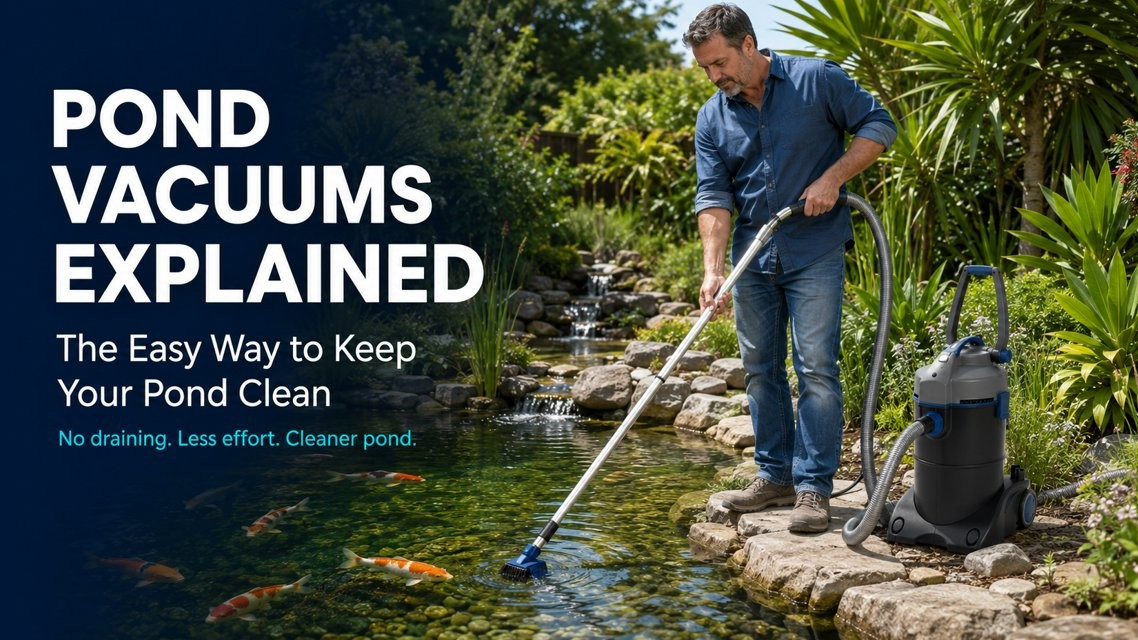
Pond Vacuums Explained: The Easy Way to Keep Your Pond Clean
No draining, no bending, no mess — everything you need to know before choosing a pond vacuum, plus which OASE model is right for your pond.
Most pond owners clean the same way their parents did: drain a bit of water, get the net out, and hope you reached the worst of it. It works, but it's slow, it's hard on your back and knees, and you can never quite get to the middle.
A pond vacuum solves all three problems at once. It sucks the sludge and debris straight off the bottom while your pond stays full and your fish stay right where they are — and it's a lot simpler to use than most people expect.
This guide walks through how a pond vacuum works, how it stacks up against cleaning by hand, and which OASE model suits your pond.
1. The Old Way: Draining & Netting
Also known as: manual pond cleaning, netting and draining
This is the method most people learn first, mainly because it doesn't need any special equipment. You lower the water level, then work through the pond by hand with a net and a hose, reaching what you can from the edge or by wading in.
It gets the job done eventually, but it asks a lot of you — time, a strong back, and a fair bit of patience with the parts of the pond you can't quite reach.
Draining & Netting: Pros
- No equipment to buy beyond a net and a hose
- Simple enough for a very small pond or water bowl
- No power point needed nearby
Draining & Netting: Cons
- Slow — often the better part of an hour, or more
- Hard on your back and knees — a lot of bending and kneeling at the edge
- Hard to reach the middle and under any shelves or ledges
- Lowers the water level and stresses your fish while the pond refills
2. The Easy Way: Using a Pond Vacuum
Also known as: pond hoover, sludge vacuum, muck vac
A pond vacuum does exactly what it sounds like — it sucks the sludge and debris straight off the bottom of your pond, while the water, and your fish, stay right where they are. No draining, no nets, no getting your hands dirty.
Think of it like vacuuming a carpet, except this "carpet" is underwater and full of fish you don't want to disturb. Run the hose along the bottom, and years of build-up disappears in minutes.
Pond Vacuum: Pros
- No bending or kneeling — you operate it standing at the edge
- Reaches the whole floor, including corners and under shelves
- Clears years of build-up in minutes, not hours
- Fish stay undisturbed in the pond the whole time
Pond Vacuum: Cons
- More to spend upfront than a net and a hose
- Canister needs emptying partway through on the Classic (the 4 & 5 empty themselves as you go)
- Needs a power point within reach of the pond
3. Side-by-Side Comparison
| Feature | Draining & Netting | Pond Vacuum |
|---|---|---|
| Typical Time Required | 45–60+ minutes | 10–15 minutes |
| Physical Effort | High — bending & kneeling | Low — stand at the edge |
| Draining Needed | Yes, partial | No |
| Reaches Full Pond Floor | Limited | Yes, including corners |
| Disturbs Fish | Yes — lowered water level | Minimal |
| Best For | Very small ponds, light touch-ups | Most ponds, especially koi & larger ponds |
4. Which Model Suits Your Pond?
Still unsure? Use these scenarios as a guide:
Small Ornamental Pond
Recommended: Pondovac Classic
An entry-level clean for ponds up to about 5,000 litres — simple to operate and easy on the budget.
Koi Pond With Regular Fish Waste
Recommended: Pondovac 4
Continuous dual-chamber suction, so you're not stopping to empty a canister on a pond that needs a proper clean.
Large Pond or Multiple Ponds
Recommended: Pondovac 5
The integrated pump-out and biggest hose lengths handle 20,000L+ ponds, or several ponds in one visit.
First Pond Vacuum, Modest Budget
Recommended: Pondovac Classic
Everything a first-time buyer needs, without paying for capacity a small backyard pond won't use.
Time-Poor Pond Owners
Recommended: Pondovac 4 or Pondovac 5
Continuous suction means you're never pausing to tip out a canister — you clean the whole pond in one uninterrupted pass.
5. How Much Time Does It Save?
The biggest difference isn't just comfort — it's how much of your weekend you get back. Draining, netting, waiting for the pond to refill, and settling your fish back in adds up fast.
45–60+
Minutes (Typical)
Draining & Netting
A physical, multi-step clean
10–15
Minutes (Typical)
Pond Vacuum
Straight to the sludge, no draining
Exact times depend on your pond size and how long it's been since the last clean — but the difference in effort is the real win.
6. Full Spec Comparison: Classic vs Pondovac 4 vs Pondovac 5
We're an authorised OASE Australia dealer, and we keep all three models in stock. Here's exactly how they compare:
| Spec | Pondovac Classic | Pondovac 4 | Pondovac 5 |
|---|---|---|---|
| Motor Power | 1,400 W | 1,700 W | 2,400 W (1,700 W + 900 W) |
| Flow Rate | 3,000 L/h | 5,000 L/h | 8,000 L/h |
| Suction Depth | Up to 2.0 m | Up to 2.4 m | Up to 2.5 m |
| Tank Capacity | 27 L | 27 L | 33 L (direct pump-out) |
| Suction Operation | Intermittent | Continuous (dual chamber) | Continuous (integrated pump) |
| Suction Hose Length | 4 m | 5 m | 5 m |
| Drain Hose Length | 2 m | 2.5 m | 8 m |
| Weight | ~9.5 kg | ~13.1 kg | ~24.3 kg |
| Ideal Pond Size | Up to ~5,000 L | Up to ~20,000 L | 20,000 L+ |
7. Getting Started: A Simple Checklist
- Clear any large leaves or debris off the surface first, by hand or with a net
- Switch on the vacuum and slowly guide the nozzle along the bottom of the pond
- Move at a gentle, steady pace — there's no need to rush
- Let the canister empty automatically, or empty it yourself once full
- Work your way around the whole pond, including corners and under any shelves
- Give your filter a clean once you're done, so it isn't working against fresh build-up
8. Frequently Asked Questions
Ready to Clean Up?
Shop OASE Pond Vacuums
We're an authorised OASE Australia dealer with the Pondovac Classic, Pondovac 4 and Pondovac 5 available — plus free advice if you're not sure which size suits your pond.
Recent Posts
-
Pond Vacuums Explained: Easy Pond Cleaning | DIYMegaStore
Pond Vacuum Buying Guide Pond Vacuums Explained: The Easy Way to Keep Your Pond Clean No draining, …4th Sep 2026 -

BBA PurePond Complete Range Guide — Which Product Does Your Pond Need?
Australian Made & Owned BBA Biosolution PurePond Complete Range Guide Australia's most conce …22nd Jun 2026 -

Projecting Curtain Effect vs Wall Wash Effect Water Walls: Which One is Right for You?
Water Wall Buying Guide Projecting Curtain Effect vs Wall Wash Effect Water Walls: Which One is …22nd May 2026