null
​Luponds Stainless Steel vs Luponds Acrylic Water Wall Spillways: Which Is Right for You?

​Luponds Stainless Steel vs Luponds Acrylic Water Wall Spillways: Which Is Right for You?

Buyer's Guide · Water Wall Spillways

Stainless Steel vs Acrylic
Water Wall Spillways
— Which Is Right for You?

Two premium Luponds spillway materials. One important decision. Here's everything you need to choose confidently — for your pool, garden, or outdoor feature.

By DIYMegaStore Water Wall Experts  ·  Updated July 2026  ·  7 min read

A water wall spillway is one of the most impactful features you can add to an outdoor space — whether it's a poolside blade, a garden feature, or an architectural wall installation. But before you achieve that perfectly flowing sheet of water, you need to answer one key question: stainless steel or acrylic?

Luponds offers both materials in a range of sizes to suit DIY and professional installs across Australia. This guide breaks down every difference that matters — from durability in harsh Australian conditions to the look and sound of the water flow — so you can pick the right spillway with confidence.

Quick Verdict

Stainless Steel

Built to Last

Max Durability Low Maintenance Pool & Outdoor Premium Look

Acrylic

Striking Clarity

Budget-Friendly Crystal Clear Projecting Curtain Shaded / South-Facing
Bottom line: Choose stainless steel if longevity and low maintenance are your priority — especially for a fully sun-exposed poolside, coastal, or north-facing installation. Choose acrylic if you want a crystal-clear projecting curtain effect on a tighter budget, and your wall is shaded or south-facing (Australia's naturally protected aspect) — it works beautifully around chlorinated or saltwater pools too.
1

Material & Durability

Stainless Steel
  • Marine-grade steel — 304 or 316 grade available
  • Exceptional corrosion and rust resistance for Australian conditions
  • Fully UV-resistant — handles sun, heat and humidity without degrading
  • 316 marine grade recommended for coastal and saltwater pools
  • Structurally robust — resists impact and warping
Acrylic
  • Commercial-grade cast acrylic — clear as glass
  • Durable under normal conditions; sensitive to prolonged, direct UV
  • Best in shaded or south-facing positions — in Australia, south-facing walls receive far less direct sun than north-facing
  • Once installed, only the lip and water-contact face are exposed to the sky — not a full sheet, which further reduces real-world UV exposure
  • Lighter than steel — easier single-person handling
  • Avoid sharp impacts — more prone to scratching than metal
Orientation matters — and most acrylic advice gets this backwards for Australia: In Australia— north-facing walls get the strongest, most direct sun, while south-facing walls are the shaded aspect. Combined with the fact that only the spillway's lip is exposed once installed, acrylic holds up well on shaded or south-facing walls. For a wall in full north-facing sun most of the day, stainless steel remains the lower-maintenance long-term choice.
2

Aesthetic Appeal

Stainless Steel
  • Semi-brushed satin finish — contemporary and refined
  • Clean lines suit modern architecture and pool surrounds
  • Reflective surface catches light for an elegant daytime look
  • Pairs beautifully with stone cladding, concrete and timber
  • Timeless — won't look dated as design trends evolve
Acrylic
  • Crystal-clear transparency — the water flow becomes the feature
  • Works across modern, tropical and traditional styles
  • Spillway body “disappears” — only water movement is visible
  • Particularly striking when paired with LED underwater lighting
  • Creates a sought-after “floating water curtain” effect
3

Performance & Water Flow

Stainless Steel
  • Flow style: Thick, smooth, heavy sheet — dramatic and powerful
  • Projection: Shorter — water falls close to the wall face
  • Volume: High volume for a full, consistent curtain
  • Water types: Fresh, chlorinated & salt water
  • Lip size: 35mm · Bottom inlets only
Acrylic
  • Flow style: Thin, delicate, glass-like sheet — graceful and refined
  • Projection: Greater distance — ideal projecting curtain effect
  • Volume: Thinner sheet; visually elegant
  • Water types: Fresh, chlorinated & salt water — genuinely popular for pool surrounds, not just a budget option
  • Lip sizes: 40mm (back inlets) · 135mm (bottom inlets)
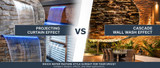
Choosing your water effect: Want water to cascade close to the wall? Choose stainless steel. Want the water to project outward as a glass curtain? Choose acrylic. See our Projecting Curtain vs Wall Wash guide →
4

Installation & Maintenance

Stainless Steel
  • Compatible with a wide range of wall materials and substrates
  • Robust build makes positioning and levelling straightforward
  • Single bottom-inlet simplifies plumbing connection
  • Resistant to discolouration — retains finish without special products
  • Lowest ongoing maintenance — wipe down as needed
  • !Tea staining may occur depending on site environment — cosmetic only, easily managed with routine cleaning
Acrylic
  • Lighter weight — easier handling on larger units
  • Handle carefully — avoid tools that could scratch the surface
  • Back-inlet option useful when plumbing must be fully concealed
  • Regular cleaning prevents algae buildup on the clear surface
  • Use acrylic-safe cleaners only — harsh chemicals cause crazing
  • Never tea-stains — no metal to react with pool chemistry

What Is Tea Staining on Stainless Steel?

Tea staining is the term used to describe the brown or rust-coloured surface discolouration that can appear on stainless steel in certain environments. Despite its alarming appearance, tea staining is a surface-level cosmetic issue only — it does not indicate corrosion of the steel itself, and the structural integrity of the spillway is not affected. This applies to both 304 and 316 grade, though 316 is significantly more resistant.

It occurs when fine iron or chloride particles from the surrounding environment settle on the steel surface and react with moisture to leave brownish deposits. Common contributing factors include proximity to the ocean (salt air), nearby construction or grinding work, salt-chlorinated pools (where dissolved salt levels run considerably higher than plain chlorinated water), or infrequent cleaning that allows deposits to build up and dry on the surface.

Step 1 — Regular Rinse

Rinse the spillway with fresh water weekly, especially in coastal or salt-chlorinated pool environments. This removes salt and chloride deposits before they have a chance to stain.

Step 2 — Mild Clean

For light staining, wipe with a soft cloth dampened with warm soapy water or a mild stainless steel cleaner. Always wipe in the direction of the grain — never in circles, which can scratch the brushed finish.

Step 3 — Stubborn Stains

For heavier discolouration, use a dedicated stainless steel restorer or a paste of baking soda and water. Apply gently with a soft cloth along the grain, rinse thoroughly, and dry. Never use steel wool or abrasive pads.

Tip: Upgrading to 316 marine-grade stainless steel significantly reduces the likelihood of tea staining compared to 304 grade, making it the recommended choice for coastal locations, saltwater pools, or any high-chloride environment. Keeping your pool's chlorine and pH within normal operating range also helps considerably — balanced water chemistry is one of the simplest ways to reduce staining risk. Read our 316 vs 304 grade comparison →

5

Cost & Long-Term Value

Stainless Steel
  • Higher upfront cost — reflects marine-grade material quality
  • Minimal lifetime maintenance costs — no replacement under normal use
  • No UV fading or yellowing — retains appearance for decades
  • Best long-term value for outdoor and permanent installations
Acrylic
  • Lower upfront cost — more accessible for budget-conscious projects
  • May need replacement sooner if installed in full north-facing sun without shade — performs well for many years on shaded or south-facing walls
  • Small ongoing cost for acrylic-safe cleaning products
  • Best value for shaded, south-facing, indoor or relocatable features
6

Who Should Choose Which?

Choose Stainless Steel if you…

  • Are building a poolside water feature or pool blade in full sun
  • Live near the coast or use saltwater chlorination
  • Want a low-maintenance, set-and-forget installation
  • Have a north-facing wall with full sun exposure most of the day
  • Prefer a bold, heavy curtain of water close to the wall
  • Are investing in a long-term permanent feature
  • Want a contemporary brushed-metal finish

Choose Acrylic if you…

  • Are working with a tighter project budget
  • Want water to project outward as a glass-like curtain
  • Are installing in a shaded garden, courtyard, indoor space, or south-facing pool wall
  • Need a back-inlet option to hide plumbing in the wall
  • Want a lighter, easier unit for a solo DIY install
  • Are pairing with LED lighting for a dramatic nighttime look
  • Prefer a transparent “invisible” spillway body
7

Full Specification Comparison

Feature Stainless Steel Acrylic
Material Marine-grade (304 or 316 SS) Commercial cast acrylic
Durability Excellent — lasts decades Winner Good — orientation-dependent
UV Resistance Full UV resistance Winner Strong on shaded/south-facing walls; avoid full north-facing sun
Water Effect Thick, heavy curtain close to wall Thin, projecting curtain from wall Winner
Projection Shorter Greater Winner
Lip Size 35mm 40mm or 135mm
Inlet Type Bottom only Back (40mm) or bottom (135mm) Flexible
Water Types Fresh, chlorinated & salt water Fresh, chlorinated & salt water
Tea Staining Possible over time (cosmetic only) — less likely on 316 grade Never occurs Winner
Finish Brushed satin — contemporary metal Crystal clear — water is the feature
Maintenance Very low Winner Moderate — regular cleaning needed
Upfront Cost Higher Lower Winner
Long-term Value Excellent — minimal ongoing cost Winner Good — excellent value if shaded or south-facing
Best For Pool, outdoor, coastal, north-facing full-sun Shaded garden, indoor, south-facing walls, pool surrounds, budget builds
8

Frequently Asked Questions

There's no single “better” option — it depends on your project. Stainless steel wins on durability, UV resistance, and low maintenance, making it ideal for permanent outdoor and poolside water features in full sun. Acrylic wins on price and creates a more dynamic projecting water curtain, making it great for shaded, south-facing, or indoor installations on a budget.
It depends on orientation. In Australia, north-facing walls get the most direct sun, while south-facing walls are the shaded aspect — the opposite of what many general acrylic care guides (written for the Northern Hemisphere) assume. Acrylic also only has its lip and water-contact face exposed once installed, rather than a full sheet sitting in the open, which further reduces real-world UV exposure. For a north-facing wall in full sun most of the day, stainless steel is the lower-maintenance choice. For a shaded or south-facing wall, acrylic performs well long-term.
Yes — acrylic is a genuinely popular choice for pool surrounds, not just a budget compromise. It's rated for fresh, chlorinated and salt water the same as our stainless range, never tea-stains, and produces the clear, dynamic projecting curtain many pool owners prefer. The main consideration is sun exposure rather than pool chemistry: acrylic is the better material for a shaded or south-facing pool wall, while a fully sun-exposed, north-facing pool wall suits 316 marine grade stainless best.
Yes — both stainless steel and acrylic Luponds spillways are compatible with fresh, chlorinated, and salt water. For saltwater pool environments, we recommend marine-grade 316 stainless steel for superior corrosion resistance, since dissolved salt levels run higher than plain chlorinated water. Read our 316 vs 304 stainless steel guide →
Stainless steel Luponds spillways feature a 35mm lip with bottom inlets only. Acrylic models come in a 40mm lip with back inlets, or a larger 135mm lip with bottom inlets — giving you more plumbing flexibility.
Use a soft cloth and acrylic-safe cleaning solution — never abrasive scrubbers or harsh chemicals, as these scratch or craze the surface. Regular cleaning prevents algae and mineral scale build-up, which is especially important on clear acrylic where it's more visible than on brushed steel.
Absolutely. Multi-unit spillway installations are very popular for creating wider water walls or staggered feature effects. Both materials work in multi-unit configurations. DIYMegaStore offers complete multi-spillway kits and a Water Wall Kit Builder to help you plan the right setup.

Ready to Choose Your Spillway?

Browse the full Luponds range — stainless steel and acrylic water wall spillways in multiple sizes for any Australian project.

10th Nov 2025 DIYMegaStore

Recent Posts