
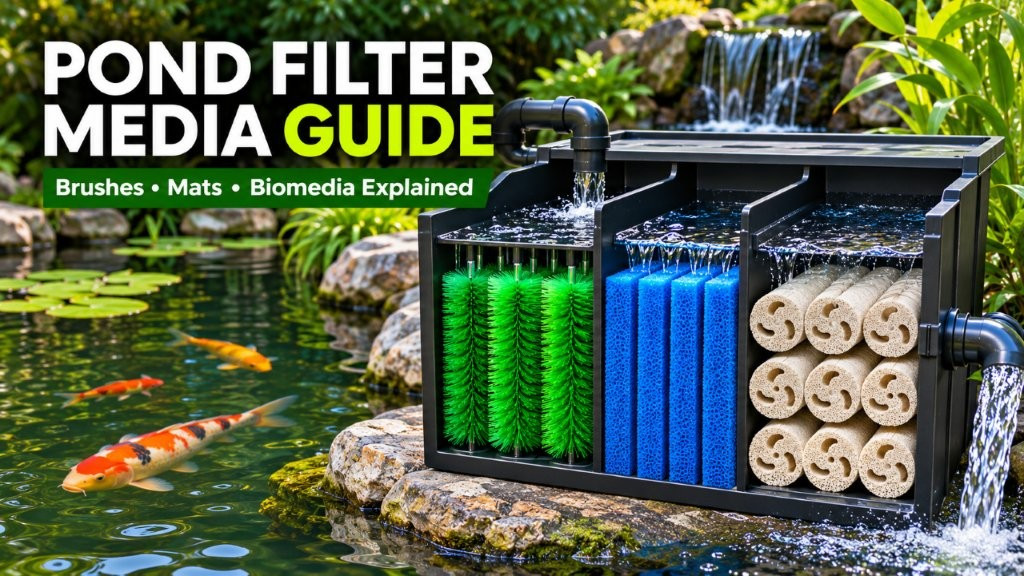
Pond Filter Media Guide: Brushes, Mats & Biomedia Explained
POND FILTER MEDIA GUIDE | 10 MIN READ
Open up a pond filter and you will find a lot of strange things inside: brushes, foam sheets, ceramic pieces, little plastic balls. They all look different, but they have one job in common. They keep your pond water clean and your fish healthy.
This guide explains in plain English what each type of filter media does, how brushes, mats, honeycomb bacteria housing and biomedia work together, how to set them up, and how to clean them without wiping out the beneficial bacteria your pond depends on. It is written for Australian ponds and Australian seasons.
Quick answer
A good pond filter needs two kinds of media. Mechanical media (brushes or mats) goes first and catches the dirt. Biological media (honeycomb bacteria housing, bio balls or biomedia) goes second and gives beneficial bacteria somewhere to live. Rinse the mechanical media often. Clean the biological media gently and rarely, using pond water, never tap water.
In this article
- What does filter media actually do?
- Mechanical vs biological filtration
- The nitrogen cycle in three steps
- Meet the media: brushes, mats, bacteria housing and biomedia
- Side-by-side comparison
- Which media should you choose?
- How to set up your filter media
- How to clean media without killing the bacteria
- Filter media through the Australian seasons
- Frequently asked questions
- Shop pond filter media
1. What does filter media actually do?
Your pond filter does not clean the water by magic. It works by passing water slowly through material, called media, that does two jobs:
- It catches solid dirt such as leaves, fish waste and floating debris, so it does not float around your pond or block your pump.
- It gives beneficial bacteria a home. These tiny living helpers break down the harmful waste you cannot see.
Without the right media, dirt builds up, waste turns to ammonia, and the water goes green or cloudy. With the right media, the filter quietly does the work for you, day and night.
2. Mechanical vs biological filtration
These two terms come up all the time, so it helps to know the difference.
| Mechanical filtration | Biological filtration | |
|---|---|---|
| What it removes | Solid dirt you can see | Invisible, harmful waste (ammonia and nitrite) |
| How it works | Dirt is trapped as water passes through | Beneficial bacteria living on the media break waste down |
| Typical media | Filter brushes, filter mats | Honeycomb bacteria housing, bio balls, biomedia |
| Cleaning | Often, when flow slows | Gently and rarely |
Many media do a little of both. A brush catches debris and grows bacteria on its bristles. That is why the best filters use a mix, with the mechanical stage first so the biological stage stays clean.
3. The nitrogen cycle in three steps
This is the reason biological media matters. Fish produce waste all day long, and that waste starts the cycle:
Step 1: Ammonia
Fish waste and uneaten food break down into ammonia. It is toxic to fish, even in small amounts.
Step 2: Nitrite
The first group of beneficial bacteria turns ammonia into nitrite. Nitrite is also harmful to fish.
Step 3: Nitrate
A second group of bacteria turns nitrite into nitrate, which is far less harmful. Plants and regular partial water changes keep nitrate under control.
These bacteria need two things: a surface to live on and a steady supply of oxygen-rich water. Good biological media provides lots of surface in a small space, and the flow from your pump supplies the oxygen. More surface area means more bacteria, and more bacteria means a bigger safety buffer for your fish.
4. Meet the media: brushes, mats, bacteria housing and biomedia
Filter brushes: the first line of defence
A filter brush is a bundle of fine stainless steel wire twisted into a long cylinder. Water flows through the bristles, which catch leaves and debris before they reach the rest of the filter. The bristles also give bacteria plenty of surface to grow on, so a brush does a little of both jobs.
The Luponds Filter Brush comes as a pack of 10, each 12cm x 60cm, with a loop at one end so you can hang it in the chamber. They are easy to pull out, rinse and put back, and they last for years.
Filter mats: cut to fit
A filter mat is a thick, open-cell sheet that you cut to fit your filter chamber. Water flows through the mat, which traps debris and uneaten food. Its large surface area also gives beneficial bacteria plenty of room to grow, so a mat works as both mechanical and biological media.
The Filter Mat in blue is a polyester mat measuring 1m x 0.5m x 40mm. Its rigid, open-cell structure resists clogging, so water keeps flowing as waste builds up, and it is described as more durable than standard filter foams. It can be used in fresh or salt water without affecting pH. Because a mat traps so much dirt, it is the part of your filter you will clean most often, so rinse it in pond water when the flow slows.
Honeycomb bacteria housing: a home for bacteria
Bacteria housing, also called a bacteria house, is a porous block designed purely for biological filtration. The honeycomb design is full of channels and tiny holes, so there is a huge amount of surface for beneficial bacteria to settle on while water flows through.
The Luponds Honeycomb Bacteria House is 5.5cm across and 16cm long per piece, and you buy as many pieces as your filter chamber needs. It is a low-cost way to add biological capacity to an existing filter.
Bio balls: the classic choice
Bio balls are small plastic spheres with an open, ridged design. Water runs over and through them, and bacteria grow on every surface. The PondMAX Bio Balls are 42mm across and come in a pack of 100. They are a simple, familiar way to fill a filter chamber, and they suit both mechanical and biological filtration.
Biomedia: maximum surface area
Biomedia is the premium end of biological filtration. It is engineered to pack as much protected surface into as little space as possible. The OASE Hel-X 13 Biomedia offers 806 m² of surface per cubic metre, and its design protects the bacteria from being scoured off by water flow. It suits moving bed and static filter chambers, and it is a strong choice for koi ponds and heavily stocked ponds.
Pro tip
In a moving bed chamber, the media needs to tumble gently. That is what keeps the surface clean and the bacteria active. If the media is sitting still in a heap, check your air supply.
5. Side-by-side comparison
| Media | Main job | Best for | Cleaning |
|---|---|---|---|
| Filter brushes | Mechanical, plus some bacteria growth | First stage of any filter | Often. Swish in pond water and shake out. |
| Filter mats | Mechanical and biological | Cut-to-size first-stage filtering | Often. Squeeze out in pond water. |
| Honeycomb bacteria housing | Biological | Low-cost extra bacteria capacity | Rarely. Gentle rinse in pond water only. |
| Bio balls | Mechanical and biological | Simple, familiar chamber fill | Occasionally. Gentle rinse in pond water. |
| OASE Hel-X 13 biomedia | Biological, very high surface area | Koi and heavily stocked ponds | Rarely. Leave it alone unless it is clogged. |
6. Which media should you choose?
Start with what your pond is telling you:
My filter keeps clogging
You need better mechanical filtration at the start. Add filter brushes or a filter mat so debris is caught before it reaches your biological media.
I want to add more bacteria capacity on a budget
Top up your chamber with honeycomb bacteria housing. It is a low-cost way to add biological surface.
I keep koi or have a heavily stocked pond
Go for maximum surface area with OASE Hel-X 13 biomedia.
My filter chamber is already full of bio balls
They still work. Keep them and top up with PondMAX Bio Balls, and make sure a brush or mat stage sits in front of them.
My water is green or my ammonia reading is high
Check how much you are feeding and how many fish you have first. Then look at whether your filter has enough biological surface for your pond. Our pond filtration selection guide will help you size it.
Not sure where to start? Call us on 1300 238 288 with your filter model and pond size, and we will point you to the right media.
7. How to set up your filter media
- Put it in the right order. Water should pass through the mechanical stage first (brushes or mats), then the biological stage (bacteria housing, bio balls or biomedia).
- Rinse new media briefly in clean water to wash off dust before it goes into the filter.
- Do not pack it too tight. Spread the media evenly through the chamber and leave gaps so water flows freely through and around it. Water that cannot flow takes the easy path around the media and the bacteria miss out.
- Hang brushes from a rod or hook using the loop at the end, so water flows through the full length of the bristles.
- Cut mats to fit. Trim the mat so it fills the chamber snugly with no gaps at the sides. Otherwise water slips around the mat instead of through it.
- Keep the water moving, 24 hours a day. The bacteria need oxygen-rich water. If there is a power cut, get the pump going again as soon as you can. A long outage can set a colony back by weeks.
- Be patient. New media needs several weeks to build up a healthy bacteria colony. OASE suggests around 4 to 6 weeks for Hel-X. Go easy on feeding while it settles, and consider adding a beneficial bacteria treatment from our BBA PurePond range to help it along.
8. How to clean media without killing the bacteria
This is where many pond owners go wrong. A sparkling clean filter sounds like a good thing, but scrubbing everything spotless wipes out the bacteria that keep your fish safe. Follow these rules:
- Use pond water, not tap water. Tap water contains chlorine, which can kill beneficial bacteria. Scoop a bucket of water from the pond and use that.
- Never use soap or detergent.
- Clean only when needed, when the flow slows or the media looks clogged, not on a fixed schedule.
- Brushes and mats first. Swish brushes in the bucket and shake out the dirt. Squeeze mats out gently. A little leftover colour is fine and is a good sign that bacteria are still there.
- Go easy on biological media. A quick gentle rinse in pond water is plenty. You are only removing loose sludge, not trying to make it look new.
- Never clean everything on the same day. Clean one section at a time and leave the rest untouched so enough bacteria remain to protect your fish.
Cleaning checklist
1. Fill a bucket with pond water. 2. Turn off the pump. 3. Lift out the brushes or mats from one section only. 4. Swish and shake out the dirt. 5. Put everything back and restart the pump straight away.
For the sludge on the pond floor, a pond vacuum does the job without disturbing your filter. See our pond vacuums guide.
9. Filter media through the Australian seasons
Beneficial bacteria are living things, and they respond to temperature just like your fish do. Much of the advice online comes from the Northern Hemisphere, so here is how it plays out in Australia:
- Winter: bacteria slow right down in cold water, especially in Melbourne, Adelaide, Canberra and Hobart. Your filter is not removing waste as quickly, so feed lightly and be extra gentle when cleaning. Avoid disturbing the biological media.
- Spring: as the water warms, the bacteria wake up and your fish start eating more. This is when many ponds hit trouble, because the fish are producing more waste before the bacteria have caught up. Build feeding up slowly. If you are installing new media, spring is a good time because warming water helps the colony establish.
- Summer: warm water and heavy feeding mean the highest waste load of the year, and warm water holds less oxygen. Keep the filter running 24/7, clean the brushes and mats more often, and consider extra aeration during heatwaves.
- Autumn: falling leaves load up your mechanical media quickly. Check and rinse your brushes or mats regularly. A pond net helps protect your filter.
10. Frequently asked questions
What is honeycomb bacteria housing?
It is a porous, honeycomb-style filter media that gives beneficial bacteria lots of surface area to live on. Some people call it a bacteria house. The bacteria break down ammonia and fish waste, which keeps your pond water clean and safe.
What is biomedia?
Biomedia, short for biological filter media, is any material designed to give beneficial bacteria a place to grow. High-performance biomedia packs a very large surface area into a small volume, so more bacteria can live in your filter.
Do I need both filter brushes and biomedia?
For best results, yes. Brushes catch solid dirt first, and biomedia or bacteria housing handles the invisible waste. Brushes also grow some bacteria themselves, so they do a little of both jobs.
How often should I clean pond filter media?
Only when water flow drops or the media looks clogged. Brushes and mats need cleaning more often than biological media. Always use pond water, never tap water, and clean one section at a time.
Why shouldn't I use tap water to clean filter media?
Tap water usually contains chlorine, which can kill the beneficial bacteria living on your media. Rinse in a bucket of pond water instead.
How long does it take for new filter media to start working?
Bacteria need time to colonise new media, usually several weeks. OASE suggests around 4 to 6 weeks for Hel-X. Warm water speeds this up, and cold water slows it down.
How much filter media does my pond need?
It depends on your pond size, how many fish you have and which filter you use. More surface area is better, as long as water still flows freely. Check your filter manual, or call us on 1300 238 288 and we will help you work it out.
Can I mix different types of filter media?
Yes, and you should. Put mechanical media such as brushes or mats first, then biological media after it. Just keep water flowing freely through the whole chamber.
FREE MEMBERSHIP
Members save more on pond supplies
Sign up for a free DIYMegaStore membership and get member-only pricing on selected products, including Porpoise Luponds koi fish food.
Members also get FREE shipping to VIC & NSW on Porpoise fish food, plus low-cost shipping for Perth members.
Join free →11. Shop pond filter media
Ready to upgrade your filter? Here is everything covered in this guide:
Porous honeycomb bacteria housing for extra biological capacity. View product → Luponds Filter Brush, 10 pack
Stainless steel filter brushes that catch debris and grow bacteria. View product → Filter Mat, 1m x 0.5m x 40mm, Blue
Cut-to-fit polyester mat for mechanical and biological filtration. View product → PondMAX Bio Balls, pack of 100
42mm bio balls for mechanical and biological filtration. View product → OASE Hel-X 13 Biomedia, 25L
Premium biomedia with very high surface area for koi ponds. View product →
Or browse the full Media, Mats & Brushes range. Questions? Call our pond specialists on 1300 238 288 (Mon to Fri 9:30am to 4:30pm, Sat 9:30am to 1:00pm, Melbourne time) or email support@diymegastore.com.au.
Recent Posts
-
Pond Filter Media Guide: Brushes, Mats & Biomedia Explained
POND FILTER MEDIA GUIDE | 10 MIN READ Open up a pond filter and you will find a lot of strange th …2nd Nov 2026 -
Pond Vacuums Explained: Easy Pond Cleaning | DIYMegaStore
Pond Vacuum Buying Guide Pond Vacuums Explained: The Easy Way to Keep Your Pond Clean No draining, …4th Sep 2026 -

BBA PurePond Complete Range Guide — Which Product Does Your Pond Need?
Australian Made & Owned BBA Biosolution PurePond Complete Range Guide Australia's most conce …22nd Jun 2026