
Swimming Pools
Building a Water Wall Next to Your Swimming Pool
A water wall alongside a pool is one of the most striking upgrades you can add to an outdoor entertaining area. But a pool environment is more demanding on your components than a standard garden water wall. Here's what's different about a pool-side install, and how you can often drive the whole feature from your existing pool pump.
Why 316L marine grade stainless is the standard for pool installs
Pool water is chlorinated (and increasingly salt-chlorinated), and both are corrosive to metal over time. 304 grade stainless, the standard used in most garden water walls, doesn't have enough molybdenum content to reliably resist this exposure. 316L marine grade stainless — the grade we recommend for every pool installation — contains added molybdenum for exactly this purpose, the same reason it's used in marine fittings and coastal architecture. Even 316 can develop light cosmetic "tea staining" over time, especially in salt pools — this doesn't affect strength or lifespan, and is easily minimised with balanced pool chemistry and an occasional rinse. See our full guide on 316 vs 304 Grade Stainless Steel for the complete comparison.
Shop our 316 Marine Grade Spillway range below, available in 600mm, 900mm, 1200mm and 1500mm widths, several bundled with a multi-colour LED light bar.
Stainless steel or acrylic — which suits a pool install?
Our Water Blade Spillway range includes both 316 stainless and acrylic, and both are suitable for pool use, rated for fresh, chlorinated and salt water. 316 stainless gives a thicker, more robust curtain effect with the strongest long-term resistance to chemical exposure — best for a fully sun-exposed wall. Acrylic gives a thinner, more delicate projecting sheet with a crystal-clear finish, never tea-stains, and is a particularly strong choice for a shaded or south-facing wall, where UV exposure is minimal. For the full comparison — including why orientation matters more than most acrylic care guides let on — read Luponds Stainless Steel vs Luponds Acrylic Water Wall Spillways.
Can you run a pool water wall off your existing pool pump?
Yes — in many setups, this is a genuinely good option. Rather than adding a second dedicated pump, you can plumb the spillway into your existing pool circulation as an auxiliary return line, using a diverter valve to send a portion of flow to the spillway while the rest continues through normal filtration. This works best with a variable speed pool pump with spare capacity, and needs a spare auxiliary port (or one added by a pool technician), a diverter valve, and correctly sized plumbing.
A dedicated pump is the better option if your pool pump is already near capacity, or if you want the water wall running independently of your filtration cycle.
Any modification to your pool's plumbing should be assessed by a licensed pool technician or plumber to avoid affecting filtration performance or voiding equipment warranties.
What effect suits a pool surround?
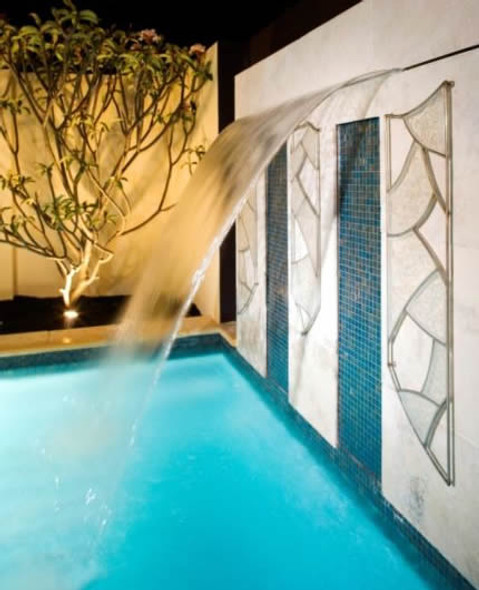
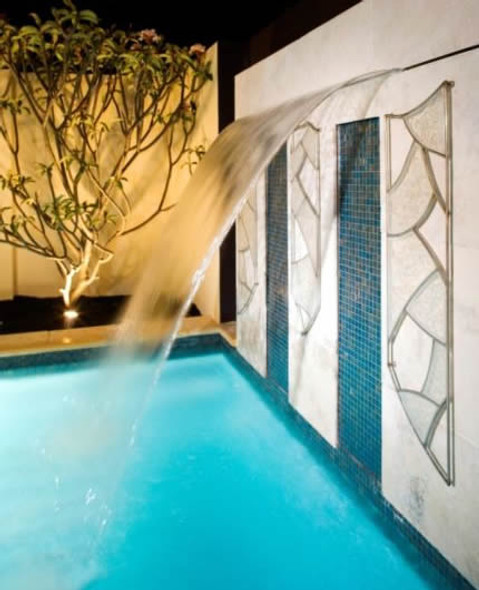
Most pool installations use a projecting curtain effect for its visual and audio impact against the water's surface. For larger surrounds, a multi-spillway installation across larger wall widths creates a genuine statement piece.
Complete your pool water wall
- LED light bars — several spillways are available bundled with a multi-colour RGB bar.
- Sealant & Forms for wall penetrations.
- For cladding, we recommend InfinitiStone, or browse our own Stone Cladding range.
For the general install process, see our full How to Build a Water Wall guide.
Talk to our water wall experts
Pool installs are different from a standard garden water wall. If you'd like assistance in choosing the right water wall spillway for your pool water wall, call 1300 238 288, or contact us here.
- Product
- Qty in Cart
- Quantity
- Price
- Subtotal
-
1500mm Marine GradeMembers Pay Less


Luponds 316 Marine Grade Stainless Steel Spillway Blade — 1500mm 35mm Lip
Luponds
$699.00$639.50Luponds 1500mm Wide Stainless Steel Water Blade A high quality marine 316 grade stainless steel waterwall spillway allows you to create a projecting curtain effect for any water wall...$699.00$639.50 -
1200mm Marine GradeMembers Pay Less


Luponds 316 Marine Grade Stainless Steel Spillway Blade — 1200mm 35mm Lip
Luponds
$569.00$468.50Entertaining outdoors used to mean just a gathering around your barbeque. With our range of premium wall mounted spillways, made from 316 stainless steel, it allows you to completely rethink how you...$569.00$468.50 -
900mm Marine GradeMembers Pay Less

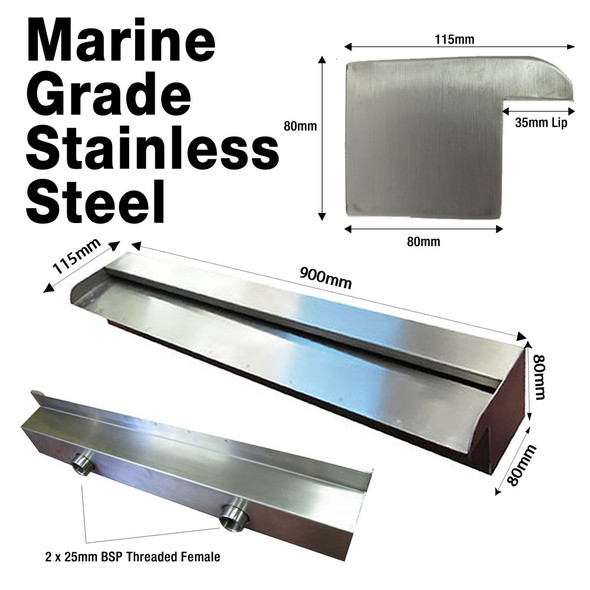
Luponds 316 Marine Grade Stainless Steel Spillway Blade — 900mm 35mm Lip
Luponds
$379.00$289.00Entertaining outdoors used to mean just a gathering around your barbeque. With our range of premium wall mounted spillways, made from 316 stainless steel, it allows you to completely rethink how you...$379.00$289.00 -
600mm Marine GradeMembers Pay Less


Luponds 316 Marine Grade Stainless Steel Spillway Blade — 600mm 35mm Lip
Luponds
$299.00$215.00Entertaining outdoors used to mean just a gathering around your barbeque. With our range of premium wall mounted spillways, made from 316 stainless steel, it allows you to completely rethink how you...$299.00$215.00 -
COMBO DEAL


Luponds LED Light Bar + Spillway Blade Bundle — 600mm Multi Colour RGB
Luponds
$498.00$374.20This bundled package comprising of a high quality stainless steel waterwall spillway and MULTI-COLOURS LED light bar allows you to create a projecting effect water feature and with lighting, ensures...$498.00$374.20 -
COMBO DEAL

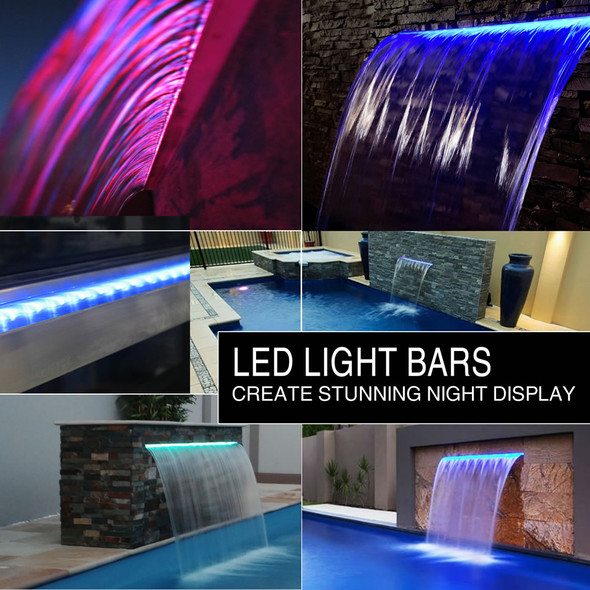
Luponds LED Light Bar + Spillway Blade Bundle — 900mm Multi Colour RGB
Luponds
$628.00$488.20This bundled package comprising of a high quality stainless steel waterwall spillway and MULTI-COLOURS LED light bar allows you to create a projecting effect water feature and with lighting, ensures...$628.00$488.20 -
COMBO DEAL


Luponds LED Light Bar + Spillway Blade Bundle — 1200mm Multi Colour RGB
Luponds
$848.00$691.70This bundled package comprising of a high quality stainless steel waterwall spillway and MULTI-COLOURS LED light bar allows you to create a projecting effect water feature and with lighting, ensures...$848.00$691.70 -
COMBO DEAL

Luponds LED Light Bar + Spillway Blade Bundle — 1500mm Multi Colour RGB
Luponds
$998.00$878.70This bundled package comprising of a high quality stainless steel waterwall spillway and MULTI-COLOURS LED light bar allows you to create a projecting effect water feature and with lighting, ensures...$998.00$878.70 -
Members Pay Less


LUPONDS 1200mm Acrylic Waterwall - 40mm Lip BACK INLETS
Luponds
$339.00$278.50Luponds 1200mm Wide Acrylic Water Blade with 40mm Lip These Luponds water blades are fabricated from strong grade acrylic. The slot designed lip are best suited for projecting sheet effects - ideal...$339.00$278.50 -
Members Pay Less


LUPONDS 900mm Acrylic Waterwall - 40mm Lip BACK INLET
Luponds
$299.00$229.50Luponds 900mm Wide Acrylic Water Blade with 40mm Lip Luponds water blades are fabricated from strong grade acrylic with double baffle system you are guaranteed the most consistent smooth sheet of...$299.00$229.50 -
Members Pay Less


LUPONDS 900mm Acrylic Waterwall - 135mm Lip BOTTOM INLET
Luponds
$349.00$259.50Luponds 900mm Wide Acrylic Water Blade with 135mm Lip Luponds Acrylic Water Blades with a 135mm lip are specifically designed to allow you to create waterfalls through masonry walls up to 130 mm...$349.00$259.50 -
Members Pay Less


LUPONDS 1500mm Acrylic Waterwall- 135mm Lip BOTTOM INLETS
Luponds
$499.00$415.95Luponds 1500mm Wide Acrylic Water Blade with 135mm Lip Luponds water blades are fabricated from strong grade acrylic with double baffle system you are guaranteed the most consistent smooth sheet of...$499.00$415.95 -
Members Pay Less


LUPONDS 1200mm Acrylic Waterwall- 135mm Lip BOTTOM INLETS
Luponds
$449.00$349.00Luponds 1200mm Wide Acrylic Water Blade with 135mm Lip Luponds water blades are fabricated from strong grade acrylic with double baffle system you are guaranteed the most consistent smooth sheet of...$449.00$349.00 -


Pondmax 900mm Acrylic Waterwall - 30mm Lip BACK INLET
PondMax
$319.50Precision made Clear Edge Waterwalls are available in a range of different widths and with different lip lengths. Features Individually tested Suitable for Pond Feature or Swimming Pool...$319.50 -

Pondmax 1200mm Acrylic Waterwall 30mm Lip BOTTOM INLETS
PondMax
$350.00Precision made Clear Edge Waterwalls are available in a range of different widths and with different lip lengths. Features Individually tested Suitable for Pond Feature or Swimming Pool...$350.00 -


Pondmax 1200mm Acrylic Waterwall- 125mm Lip BACK INLETS
PondMax
$527.50Precision made Clear Edge Waterwalls are available in a range of different widths and with different lip lengths. Features Individually tested Suitable for Pond Feature or Swimming Pool...$527.50 -


Pondmax 1200mm Acrylic Waterwall125mm Lip BOTTOM INLETS
PondMax
$498.50Precision made Clear Edge Waterwalls are available in a range of different widths and with different lip lengths. Recommended Flow Rate (Projecting): 6000L @ Required head height Recommended...$498.50 -


Pondmax 900mm Acrylic Waterwall - 125mm Lip BACK INLET
PondMax
$379.50Precision made Clear Edge Waterwalls are available in a range of different widths and with different lip lengths. Features Individually tested Suitable for Pond Feature or Swimming Pool...$379.50 -


Pondmax 600mm Acrylic Waterwall - 30mm Lip BACK INLET
PondMax
$215.00Precision made Clear Edge Waterwalls are available in a range of different widths and with different lip lengths. Features Individually tested Suitable for Pond Feature or Swimming Pool...$215.00 -


Pondmax 1200mm Acrylic Waterwall - 30mm Lip BACK INLETS
PondMax
$339.00Precision made Clear Edge Waterwalls are available in a range of different widths and with different lip lengths. Features Individually tested Suitable for Pond Feature or Swimming Pool...$339.00 -


Pondmax 900mm Acrylic Waterwall- 30mm Lip BOTTOM INLET
PondMax
$319.50Precision made Clear Edge Waterwalls are available in a range of different widths and with different lip lengths. Features Individually tested Suitable for Pond Feature or Swimming Pool...$319.50 -
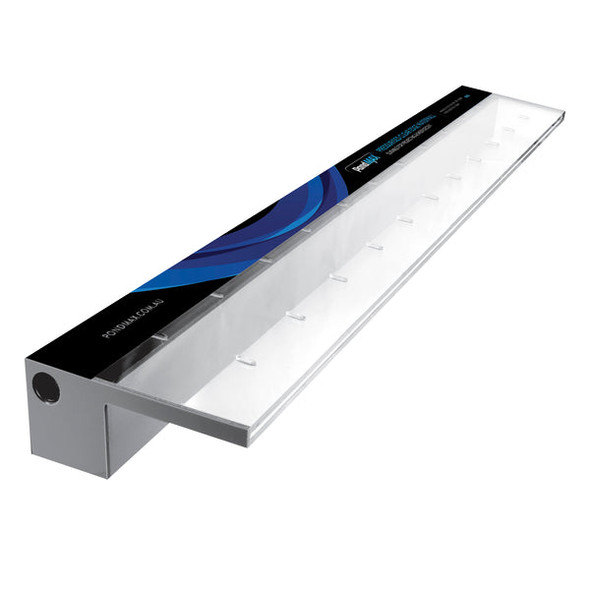

Pondmax 600mm Acrylic Waterwall- 125mm Lip BOTTOM INLET
PondMax
$269.00The 125mm lip variants of the PondMAX clear edge waterwalls are normally used for installation at the top of walls of where cladding is not being applied.Only the 15mm lip protrudes through the wall...$269.00 -


Pondmax 600mm Acrylic Waterwall- 30mm Lip BOTTOM INLET
PondMax
$215.00Precision made Clear Edge Waterwalls are available in a range of different widths and with different lip lengths. Features Individually tested Suitable for Pond Feature or Swimming Pool...$215.00 -

Pondmax 900mm Acrylic Waterwall- 125mm Lip BOTTOM INLET
PondMax
$379.50Precision made Clear Edge Waterwalls are available in a range of different widths and with different lip lengths. Features Individually tested Suitable for Pond Feature or Swimming Pool...$379.50