
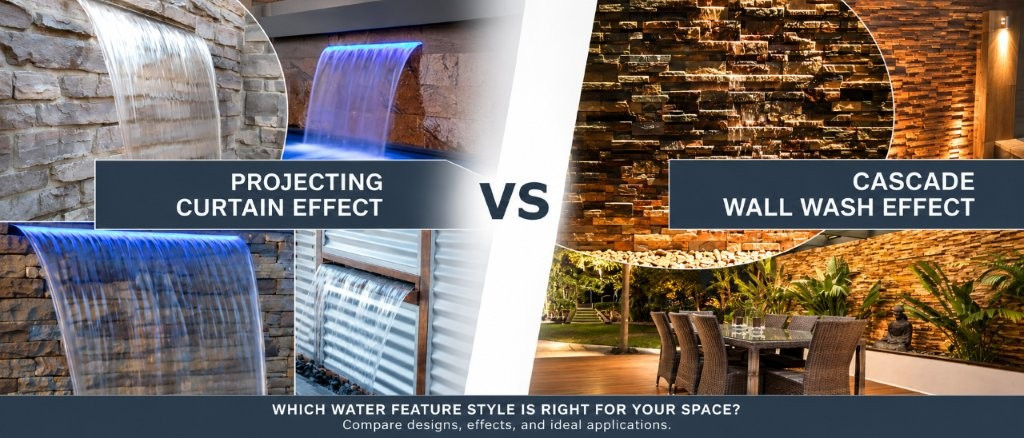
Projecting Curtain Effect vs Wall Wash Effect Water Walls: Which One is Right for You?
Water Wall Buying Guide
Projecting Curtain Effect vs Wall Wash Effect Water Walls: Which One is Right for You?
Two spectacular water wall styles, one important choice. Here’s everything you need to know before buying a DIY water wall spillway in Australia.
Water walls are one of the most striking additions you can make to a home, garden, pool surrounds, or commercial space. The gentle sound of flowing water, combined with a visually captivating feature wall, transforms any environment into something truly special.
But when you start shopping for a DIY water wall spillway in Australia, you’ll quickly encounter two distinct design approaches: the projecting curtain effect and the wall wash (cascade) effect. While both use the same core components — a spillway blade, a pump, and a reservoir — the visual results are dramatically different.
This guide breaks down everything you need to know about each style, so you can make the right choice for your space, budget, and aesthetic goals.
1. What Is the Projecting Curtain Effect?
Also known as: sheer descent effect, projecting sheet effect, water curtain
The projecting curtain effect creates a free-standing sheet of water that flows out and away from the spillway lip, hovering in mid-air before cascading into a pond or basin below. At higher flow rates, it produces a glass-like solid curtain; at lower rates, a finer veil-like flow.
This is the more dramatic of the two styles. The water visibly separates from the wall surface, creating a floating, cinematic water feature that becomes the centrepiece of any outdoor or indoor space.
Projecting Curtain Effect: Pros
- Visually dramatic — the floating water sheet is a true showstopper
- Highly photogenic — catches light beautifully, especially with LED backlighting
- Audible water sound — creates a pleasant, noticeable ambient sound
- Works with both stainless steel and acrylic spillways
- Ideal for feature walls, pool edges, and entertainment areas
Projecting Curtain Effect: Cons
- Higher pump flow rate required — minimum 230 L/min per metre of spillway width
- Requires open space — water projects outward, so you need adequate clearance
- More splash — less suited for very confined indoor settings without containment
- Spillway must be installed no higher than 900mm from water level for best results
2. What Is the Wall Wash (Cascade) Effect?
Also known as: cascade effect, wall wash effect, hugging water wall
The wall wash effect (sometimes called the cascade effect) produces a smooth, even sheet of water that flows directly down the face of your wall surface. Rather than projecting outward, the water clings softly to the material below and slides gracefully into a pool or basin.
The result is a refined, understated feature — water that appears to melt into the wall rather than float away from it. It’s an elegant look that suits contemporary architecture, indoor feature walls, and spaces where noise and splash need to be minimised.
Wall Wash Effect: Pros
- Sleek and contemporary aesthetic — water-over-stone is timeless
- Lower pump flow rate — minimum just 50–60 L/min per metre of spillway width
- Minimal splash — perfectly suited for indoor feature walls and courtyard spaces
- Works in narrow or confined spaces
- Easier to maintain and control water flow
- Lower running costs due to smaller pump requirement
Wall Wash Effect: Cons
- Less visually dramatic than a projecting curtain effect
- Quieter — if you want an audible water ambiance, this may not deliver
- Requires a smooth wall surface — textured or rough surfaces can disrupt the flow
- Only compatible with stainless steel (open-lip) spillways — not acrylic models
3. Side-by-Side Comparison
| Feature | Projecting Curtain Effect | Wall Wash / Cascade Effect |
|---|---|---|
| Visual Drama | Very High | Moderate |
| Min. Pump Flow Rate | 230 L/min per metre | 50–60 L/min per metre |
| Splash Level | Moderate to High | Low |
| Sound Level | Noticeable & pleasant | Subtle |
| Suitable Indoors? | With containment | Yes — ideal |
| Compatible Spillways | Stainless steel & acrylic | Stainless steel only (open lip) |
| Wall Surface Needed? | No — water projects freely | Yes — must be smooth |
| Running Cost | Higher (larger pump) | Lower (smaller pump) |
| Best Setting | Pool, alfresco, open outdoor areas | Indoor, courtyard, narrow spaces |
4. Which Effect Suits Your Space?
Still unsure? Use these scenarios as a guide:
Pool Edge / Spa
Recommended: Projecting Curtain
The dramatic sheet effect creates a luxurious resort feel. Use a marine-grade 316 stainless steel spillway for chlorinated water.
Indoor Feature Wall
Recommended: Wall Wash
Minimal splash, quiet operation, and a sleek aesthetic make this perfect for living rooms, offices, and foyers.
Garden / Outdoor Entertaining
Either works
Choose projecting curtain for drama and sound, or wall wash for elegant simplicity. Both create a beautiful focal point in a garden setting.
Commercial / Lobby Space
Recommended: Projecting Curtain
High visual impact makes an instant impression. Multi-unit spillway configurations allow you to span large wall widths.
Courtyard / Small or Narrow Space
Recommended: Wall Wash
Since the water flows directly down the wall rather than projecting outward, a wall wash effect requires very little clearance and is ideal for space-constrained areas.
5. Pump & Flow Rate Requirements
One of the biggest practical differences between the two effects is the pump size you’ll need. Getting this right is critical — underpowering your pump is the most common DIY water wall mistake.
230+
Litres / Min / Metre
Projecting Curtain
High-head pump required
50–60
Litres / Min / Metre
Wall Wash Effect
Standard pump sufficient
All DIY water wall kits at DIYMegaStore include a matched pump for your chosen effect, along with a flow controller so you can fine-tune the water output. A flow controller is essential for dialling in the exact look you’re after.
6. Choosing the Right Spillway Blade
Your water wall spillway blade (also called a water blade or water feature spillway) is the heart of your water wall. The material and lip design directly influence which effects are achievable.
| Spillway Type | Wall Wash | Projecting Curtain | Water Type |
|---|---|---|---|
| 304 Grade Stainless Steel (open lip) | Fresh water only | ||
| 316 Marine Grade Stainless (open lip) | Fresh, chlorinated & saltwater | ||
| Acrylic Spillway (narrow lip) | Fresh water only |
Luponds spillways are available in widths from 300mm up to 1500mm, and can be combined in multi-unit configurations to span wider walls. Popular options include the 300mm, 600mm, 900mm, and 1200mm blades.
7. Frequently Asked Questions
Ready to Create Your Water Feature?
Shop DIY Water Wall Kits & Spillways
Australia’s largest range of Luponds stainless steel water wall spillways, complete DIY kits, pumps, LED lighting, and accessories — all with free expert advice.
Recent Posts
-
Projecting Curtain Effect vs Wall Wash Effect Water Walls: Which One is Right for You?
Water Wall Buying Guide Projecting Curtain Effect vs Wall Wash Effect Water Walls: Which One is …22nd May 2026 -
Best Pond Filters Australia 2026
● UPDATED MAY 2026 Best Pond Filters Australia 2026:The Complete Buyer's Guide ✍️ DIYMegastore …7th May 2026 -

Members Always Pay Less on Porpoise Koi Fish Food | DIYMegaStore
Members Pay Less Save Big on Porpoise Koi FoodWhen You Join for Free DIYMegaStore members unlock e …6th Mar 2026